
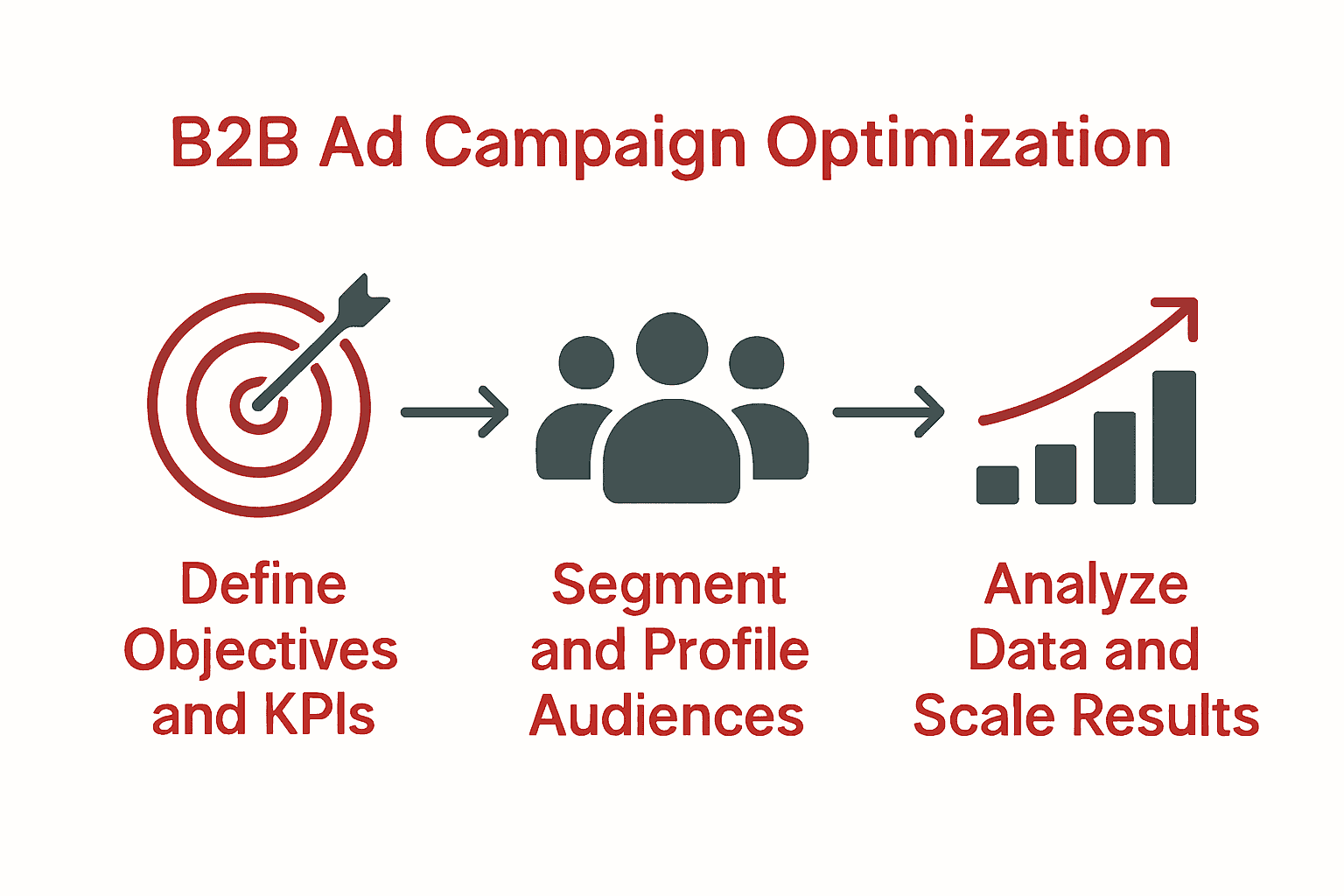
Did you know that companies with well-defined B2B ad campaign strategies are more than twice as likely to achieve significant ROI compared to those without clear goals? In a crowded marketplace, businesses can no longer rely on guesswork to attract the right prospects or close important deals. By focusing on measurable objectives and data-driven decisions, you can turn every marketing dollar into real results that matter for growth.
Quick Summary
| Key Point | Explanation |
|---|---|
| 1. Define clear campaign objectives | Establish specific business outcomes and KPIs to guide your ad strategies effectively. |
| 2. Segment your target audience carefully | Use firmographic data to create detailed profiles of segments that are likely to convert. |
| 3. Develop compelling ad creative | Ensure your messaging directly addresses your audience’s pain points and aspirations. |
| 4. Implement precise tracking mechanisms | Set up event tracking to measure meaningful interactions that align with your business goals. |
| 5. Test and scale successful campaigns | Pilot strategies through controlled experiments and gradually expand effective campaigns to optimize performance. |
Table of Contents
- Step 1: Define Key Campaign Objectives And Kpis
- Step 2: Identify And Segment Your Ideal Target Audience
- Step 3: Develop High-Converting Creative And Messaging
- Step 4: Set Up Precise Tracking And Conversion Measurement
- Step 5: Analyze Data And Implement Performance Improvements
- Step 6: Test, Refine, And Scale Winning Campaigns
Step 1: Define key campaign objectives and KPIs
When launching a B2B ad campaign, your first critical step is mapping out crystal clear objectives and performance metrics that will guide your entire strategy. Think of this as creating a strategic roadmap that transforms vague aspirations into measurable results.
Start by identifying specific business outcomes you want to achieve. Are you looking to generate qualified leads, increase brand awareness, drive website traffic, or boost direct sales? Each objective requires different tracking mechanisms. According to research from conversion tracking principles, you will want to establish precise key performance indicators (KPIs) such as conversion rate, click-through rate, registration rate, and interaction rate.
A practical approach involves breaking down your primary goal into granular, trackable metrics. For a lead generation campaign targeting professional services, your KPIs might include:
- Number of qualified leads generated
- Cost per lead acquired
- Lead to meeting conversion rate
- Average lead value
The Predictive Incrementality by Experimentation (PIE) research suggests using controlled experiments to validate your campaign’s actual impact.
Here’s a summary of common B2B campaign objectives and matching KPIs:
| Objective | Recommended KPI(s) | Measurement Focus |
|---|---|---|
| Lead Generation | Number of qualified leads Cost per lead Lead to meeting rate |
Quality and efficiency of lead flow |
| Brand Awareness | Click-through rate Impression share |
Campaign reach and engagement |
| Website Traffic | Website visits Interaction rate |
Depth of prospect engagement |
| Direct Sales | Conversion rate Average lead value |
Revenue and deal creation |
Pro Tip: Always align your KPIs directly with your core business objectives. Vanity metrics like impressions mean nothing if they do not translate into meaningful business outcomes.
By meticulously defining your objectives and KPIs upfront, you set the foundation for a data-driven, results-oriented ad campaign that can be systematically optimized and improved.
Step 2: Identify and segment your ideal target audience
Zeroing in on your perfect audience is like crafting a precision instrument for your B2B marketing efforts. Your goal is to transform a broad market into a laser-focused group of potential customers who are most likely to convert and drive meaningful business growth.
Research on firmographic segmentation reveals powerful strategies for pinpointing your ideal customers. According to experts in B2B targeting, you will want to construct a detailed profile using multiple dimensions. This means looking beyond basic demographics and diving deep into characteristics that truly define your most valuable prospects.
Start by auditing your existing customer base. What commonalities emerge among your top clients? Look closely at factors like:
- Industry vertical
- Company size
- Annual revenue
- Growth stage
- Technological infrastructure
- Specific business challenges
Firmographic data becomes your foundation for effective lead generation. By combining insights from your CRM with external market data, you can create highly specific audience segments that dramatically improve campaign precision.
Pro Tip: Do not just collect data. Map how each segment connects to specific pain points and potential solutions your business offers.
Account Based Marketing (ABM) frameworks can help you tier these segments strategically. This approach allows you to personalize your messaging and targeting at scale, ensuring each communication feels tailored and relevant to the specific audience segment.
The key is moving from broad targeting to surgical precision. Your marketing becomes less about reaching everyone and more about reaching the right someone who is most likely to become a high value customer.

Step 3: Develop high-converting creative and messaging
Creating compelling ad creative is about speaking directly to your audience’s deepest professional challenges and aspirations. Your messaging needs to transform from generic noise into a precise signal that resonates with your ideal customer’s specific pain points and desired outcomes.
Start by crafting a clear value proposition that answers one critical question for your audience: What tangible problem will you solve for their business? Your messaging should move beyond surface level benefits and dig into the transformative impact your solution delivers.
Break down your creative development into strategic components:
- Headline that captures immediate attention
- Subheadline explaining unique value
- Body copy highlighting specific business outcomes
- Clear call to action that feels like an opportunity
Conversion rate optimization demands that your creative speaks directly to your audience’s emotional and rational decision making drivers. Think about the professional challenges keeping your prospects awake at night and frame your solution as the relief they desperately need.
Pro Tip: Test multiple creative variations. What sounds compelling to you might not resonate with your target audience.
Personalization is key. Your messaging should feel like a tailored conversation rather than a broadcast. Use language that mirrors how your ideal customers describe their challenges and use specific industry terminology that demonstrates deep understanding.
Remember that high performing B2B creative is not about being clever. It is about being crystal clear, relevant and demonstrably valuable. Your goal is to make potential clients think Your solution is exactly what I need right now.
Step 4: Set up precise tracking and conversion measurement
Tracking is the nervous system of your B2B ad campaign measuring every critical signal that tells you whether your marketing efforts are generating real business results. Your goal is to transform raw data into actionable insights that drive strategic decision making.
According to conversion tracking research, implementing JavaScript or pixel trackers allows you to capture granular performance metrics that go far beyond surface level impressions. These tools enable you to understand exactly how potential customers interact with your marketing assets.
Start by identifying the most critical conversion events for your business. These might include:
- Completed lead generation form submissions
- Scheduled consultation requests
- Downloaded content asset interactions
- Webinar registrations
- Direct sales inquiries
Website conversion strategies recommend setting up event tracking that maps each interaction to your specific business objectives. This means configuring your analytics platforms to track not just clicks but meaningful engagement that demonstrates genuine buyer intent.
The Predictive Incrementality by Experimentation method suggests designing your tracking to measure causal impact. This means going beyond simple correlation and understanding which specific marketing actions directly contribute to revenue generation.
Pro Tip: Configure conversion tracking before launching your campaign. Retrofitting measurement is exponentially more difficult than building it into your initial strategy.
Utilize multi touch attribution models that capture the entire customer journey. This provides a comprehensive view of how different touchpoints influence eventual conversions allowing you to optimize your marketing mix with surgical precision.
Remember that effective tracking is not about collecting data. It is about transforming data into strategic intelligence that continuously improves your marketing performance.
Step 5: Analyze data and implement performance improvements
Data analysis transforms raw numbers into strategic insights that can dramatically reshape your B2B marketing performance. Your mission is to become a detective uncovering hidden patterns and opportunities within your campaign metrics.
Research on B2B market segmentation highlights the importance of combining internal and external data sources. This means looking beyond surface level analytics and creating a comprehensive view of your marketing ecosystem.
Start by conducting a thorough performance audit across multiple dimensions:
- Conversion rates by audience segment
- Cost per acquisition for each channel
- Engagement metrics across different creative variations
- Revenue impact of specific marketing touchpoints
- Comparative performance between target account profiles
Understanding conversion optimization requires a holistic approach. You are not just looking at numbers but interpreting the story behind those metrics.
According to research on target account strategies, developing detailed persona profiles helps translate raw data into actionable optimization strategies. This means understanding not just what happened but why it happened.
Pro Tip: Create a regular rhythm of data review. Weekly quick looks and monthly deep dives prevent performance drift and keep your campaigns agile.
Implement a systematic approach to performance improvements. Start with your lowest performing segments and creative assets. Continuously test incremental changes rather than making radical shifts that could disrupt existing performance.
Remember that data analysis is an ongoing conversation with your marketing performance. Each insight is not an endpoint but a stepping stone to more refined targeting and messaging.
Step 6: Test, refine, and scale winning campaigns
Scaling successful B2B ad campaigns is like conducting a sophisticated scientific experiment where your marketing budget becomes the laboratory and your audience segments are the test subjects. Your objective transforms from initial exploration to strategic expansion of your most promising marketing approaches.
Research on campaign validation suggests piloting your strategies through targeted experiments before full deployment. This means creating controlled environments where you can gather granular insights from both marketing performance metrics and direct sales team feedback.
Implement a systematic testing approach with these core strategies:
- Create multiple creative variations
- Test different audience segments
- Experiment with distinct messaging angles
- Compare performance across targeting parameters
- Track incremental improvements
Understanding paid ad campaigns requires a methodical approach to scaling. Start by identifying your top performing segments and creative approaches with the lowest cost per acquisition and highest conversion rates.
According to LinkedIn’s targeting research, behavioral and firmographic data can significantly enhance your ability to validate and expand successful campaign segments. This means leveraging demographic reporting and matched audiences to refine your targeting precision.
Pro Tip: Allocate 20% of your budget to continuous experimentation while scaling your proven strategies.
When scaling, incrementally increase your budget and audience reach. Sudden massive expansions can destabilize your carefully crafted performance metrics. Think of scaling as a controlled acceleration rather than an explosive growth strategy.
Remember that successful campaign scaling is not about volume. It is about maintaining the same level of targeted precision that made your initial approach effective.
Ready to Unlock True B2B Campaign Growth?
Are you struggling to translate campaign data into real business wins? This article explored how many B2B companies get stuck chasing surface-level metrics instead of driving true results like qualified leads and meaningful revenue. If you have invested time into defining objectives, mapping buyer segments, running paid ads, yet still feel like your campaigns are missing the mark, you are not alone. Many high-ticket service providers hit these same roadblocks: unclear KPIs, wasted ad spend, and messaging that never quite lands. You need a smarter, fully integrated approach to turn insights into real growth.
Now is your chance to break that cycle. Discover proven frameworks and hands-on guidance at Digital Marketing Strategies & Insights for Business Growth – ST8 or go straight to ST8.com to see how our boutique team can engineer a full-funnel acquisition system tailored for your industry. Stop guessing and start scaling with precision. Ready to optimize every step of your B2B ad strategy? Let us show you a better way—visit our site and take the first step now.
Frequently Asked Questions
What are the key campaign objectives to focus on for B2B growth?
Establish specific objectives such as generating qualified leads, increasing brand awareness, or driving website traffic. Clearly define your primary goal and break it down into measurable KPIs to guide your campaign effectively.
How do I identify my ideal target audience for B2B campaigns?
Analyze your existing customer base to find common traits like industry, company size, and specific challenges they face. Create detailed audience profiles to enable precise targeting and enhance the effectiveness of your marketing efforts.
What should I include in my ad messaging for better conversion rates?
Craft a clear value proposition that addresses the specific problems your audience faces and how your solution helps. Focus on creating compelling headlines and calls to action that resonate with your target audience’s needs.
How can I set up accurate tracking for my B2B ad campaigns?
Implement tracking tools like JavaScript or pixel trackers to capture key conversion events such as lead form submissions or webinar registrations. Define and configure your analytics platforms to monitor meaningful engagements that align with your business objectives.
What steps can I take to analyze campaign performance effectively?
Conduct a thorough audit of your campaign metrics, examining aspects like conversion rates and engagement metrics across different segments. Use these insights to identify patterns and areas for performance improvement, optimizing your strategy ongoing.
How do I test and scale successful B2B ad campaigns?
Pilot your top-performing strategies through targeted experiments, adjusting audience segments and messaging as needed. Focus on incrementally increasing your budget to maintain effective targeting without destabilizing campaign performance.
Recommended
- Understanding The Guide to Paid Ad Campaigns Effectively – ST8
- Understanding Why to Optimize Ad Spend for Better Returns – ST8
- What is Google Ads for B2B? An In-Depth Explanation – ST8
- Master PPC Campaign Steps to Boost Your B2B Success – ST8
The ST8 Review
Find out where you are losing them.
Thirty checks across everything that decides whether you get found, get chosen and get paid, put in the order we would fix them.

