
Only about 7 out of every 100 clicks on Google Ads turn into meaningful actions like purchases or sign-ups, yet that one number can transform your marketing results. Whether you run an online store or offer specialized B2B services, understanding conversion rates shows if your ads truly deliver value. By learning what drives these percentages, you get the power to spot profit opportunities and strengthen your campaigns against rising competition.
Key Takeaways
| Point | Details |
|---|---|
| Importance of Conversion Rate | Google Ads conversion rate measures the effectiveness of ad interactions, with the overall average around 6.96%. Understanding this metric helps businesses assess the return on investment of their marketing efforts. |
| Industry-Specific Benchmarks | Conversion rates vary by industry, with top sectors like Automotive achieving rates over 14%. Businesses should reference these benchmarks for realistic performance expectations and tailored strategies. |
| Campaign Type Influence | Different Google Ads campaign types impact conversion rates distinctly, with Search Ads typically performing best. Selecting appropriate campaigns aligned with marketing objectives is essential for optimization. |
| Ongoing Optimization Strategies | Successful conversion rate optimization requires continuous testing, audience targeting, and employing advanced bidding strategies. Marketers should view this as an iterative process to enhance advertising effectiveness. |
Table of Contents
- Defining Google Ads Conversion Rate
- Industry Benchmarks For Conversion Rates
- How Campaign Types Affect Rates
- Factors That Influence Conversion Rate
- Optimization Strategies For Higher Conversion Rates
Defining Google Ads Conversion Rate
A Google Ads conversion rate is a critical metric that reveals the percentage of ad interactions resulting in meaningful actions for your business. According to recent analysis, the overall average conversion rate across industries hovers around 6.96%. This metric essentially tells you how effectively your advertising translates clicks into valuable customer actions like purchases, sign-ups, or lead submissions.
To calculate your conversion rate, Google uses a straightforward formula: the total number of conversions divided by the total number of ad interactions during a specific time period. For high ticket B2B service providers and professional services, understanding this metric becomes crucial for measuring marketing effectiveness and return on investment. Understanding why optimize for conversions matters can provide deeper insights into this strategic approach.
The conversion rates vary significantly across different industries and business models. While the average sits around 4% to 6.96%, some high-performing sectors might see rates as high as 10% or more. Factors like ad quality, targeting precision, landing page design, and offer relevance all play substantial roles in determining your ultimate conversion performance. Tracking and continually refining these elements can help you progressively improve your Google Ads conversion rates.
Industry Benchmarks for Conversion Rates
Google Ads conversion rates demonstrate remarkable diversity across different industries, with recent 2025 data revealing fascinating insights into performance benchmarks. According to research from LocalIQ, the overall average conversion rate sits at 7.52%, but specific sectors show dramatically different results. Top-performing industries like Automotive—Repair, Service & Parts achieve an impressive 14.67% conversion rate, while Animals & Pets and Physicians & Surgeons follow closely at 13.07% and 11.62% respectively.
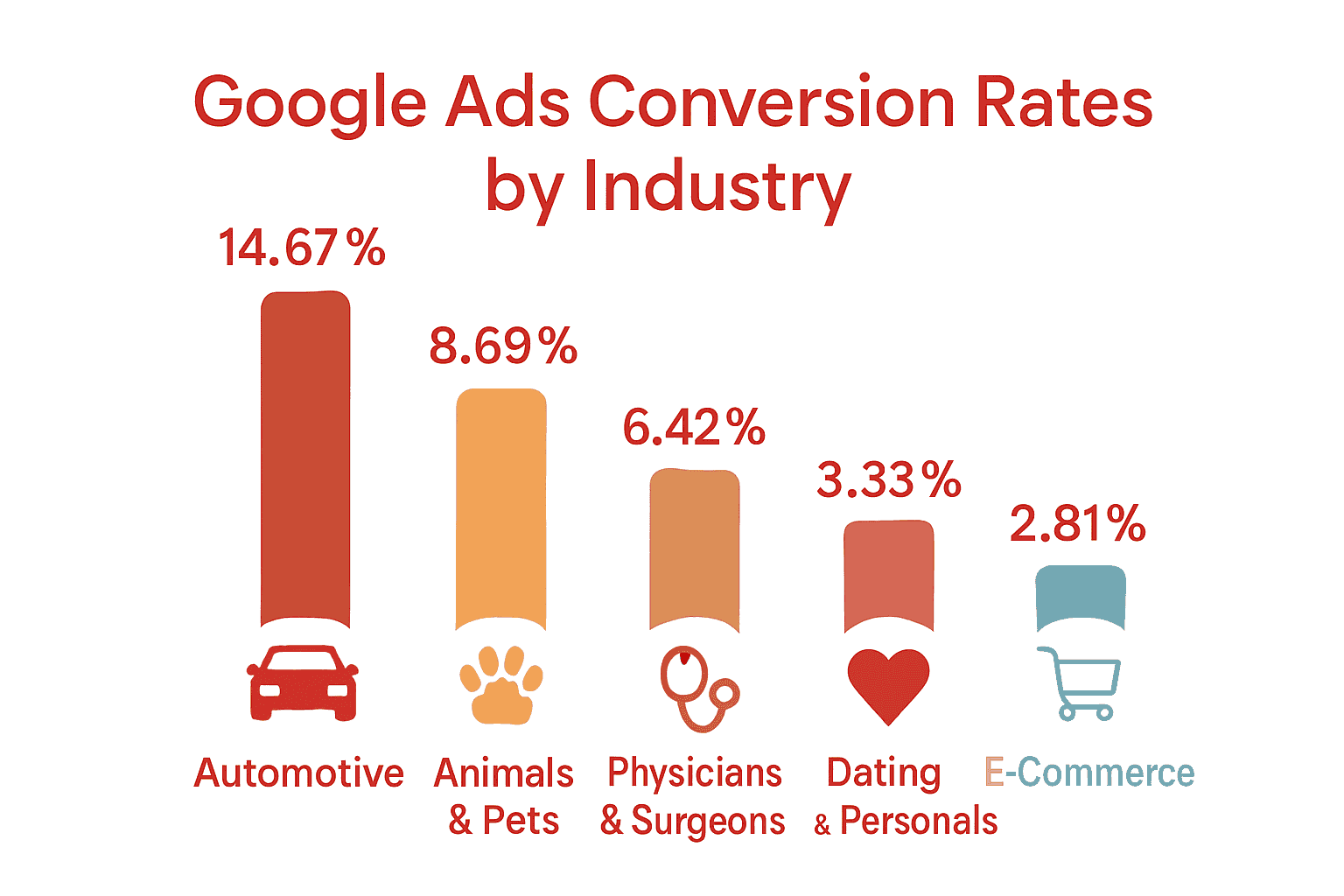
Here’s a comparison of Google Ads conversion rates by industry sector based on recent benchmarks:
| Industry Sector | Conversion Rate (%) |
|---|---|
| Automotive—Repair, Service & Parts | 14.67 |
| Animals & Pets | 13.07 |
| Physicians & Surgeons | 11.62 |
| Dating & Personals | 9.64 |
| Overall Average (LocalIQ, 2025) | 7.52 |
| E-Commerce | 2.81 |
The variation in conversion rates underscores the importance of industry-specific strategies. Research from VenueLabs highlights this diversity, showing conversion rates ranging from as low as 2.81% in E-Commerce to an impressive 9.64% in Dating & Personals. For high ticket B2B service providers, understanding these nuanced benchmarks becomes critical for setting realistic performance expectations and developing targeted optimization strategies. Essential conversion rate optimization guide for B2B success can provide deeper strategic insights for professionals looking to improve their advertising performance.
While industry benchmarks offer valuable context, they should not be treated as absolute targets. Factors like audience targeting, ad quality, landing page design, and offer relevance play substantial roles in determining actual conversion performance. High-performing businesses consistently analyze their specific metrics, test different approaches, and iteratively improve their Google Ads strategies to outperform generic industry averages.

How Campaign Types Affect Rates
Campaign types in Google Ads dramatically influence conversion rates, with each format delivering unique performance characteristics. According to research from Store Growers, Search Ads demonstrate the highest conversion potential, with certain industries like Dating & Personals achieving impressive conversion rates as high as 9.64%. This stark variation highlights the critical importance of selecting the right campaign type for your specific marketing objectives.
Research from Ad Backlog reveals nuanced differences across campaign formats. Display campaigns typically generate lower conversion rates, hovering around 0.5% to 1%, but serve crucial awareness and remarketing functions. In contrast, Shopping Ads show more varied performance, with specific sectors like HVAC & Climate Control achieving around 3.3% conversion rates. Understanding the guide to paid ad campaigns effectively can help marketers navigate these complex performance dynamics and optimize their advertising strategies.
The key to maximizing conversion rates lies in understanding each campaign type’s strengths and limitations. Search Ads excel at capturing high-intent audiences, Shopping Ads work best for product-based businesses, while Display campaigns are optimal for brand awareness and retargeting. High-performing B2B service providers continuously test and refine their approach, recognizing that the most effective strategy involves a nuanced, multi-campaign approach tailored to specific business goals and target audience behaviors.
Factors That Influence Conversion Rate
Conversion rates in Google Ads are influenced by a complex interplay of strategic factors that extend far beyond simple advertising mechanics. According to research from WebApex, critical elements like customer intent, sales cycle length, product pricing, campaign quality, and landing page experience collectively shape conversion performance. High-intent searches consistently demonstrate superior conversion potential, underscoring the importance of precise audience targeting and strategic keyword selection.
Search Engine Land’s recent analysis reveals a fascinating trend: despite rising cost per click (CPC) by approximately 13% in 2025, 65% of industries still saw conversion rate improvements, achieving an overall 6.84% increase. This suggests that sophisticated optimization strategies can effectively counterbalance increasing advertising costs. Understanding why optimize conversion rate for growth can provide deeper insights into navigating these dynamic marketing challenges.
For high-ticket B2B service providers, mastering conversion rate optimization requires a holistic approach. Key factors to consider include crafting hyper-relevant ad copy, developing compelling landing pages, implementing precise audience targeting, and continuously testing and refining campaign elements. Successful marketers recognize that conversion rate optimization is an ongoing process of incremental improvements, demanding consistent monitoring, analysis, and strategic adjustments to maintain and enhance performance.
Optimization Strategies for Higher Conversion Rates
Google Ads optimization represents a sophisticated approach to maximizing advertising performance through strategic interventions. According to research from SEO Design Chicago, leveraging automated Smart Bidding strategies can dramatically improve conversion efficiency, with techniques like maximizing conversions and broad-match targeting delivering 25–35% more conversions at consistent cost per conversion levels. This data underscores the power of intelligent, data-driven bidding approaches.
Groundbreaking academic research from a comprehensive traffic analysis study revealed an innovative optimization technique: using traffic-fingerprinting to cluster pages by performance patterns. By identifying groups of pages correlated with higher conversion profitability, marketers can make targeted campaign adjustments that potentially increase revenue by over 50%. Website conversion checklist for high ticket B2B growth can help businesses implement these advanced optimization strategies effectively.
For high-ticket B2B service providers, successful conversion rate optimization demands a multi-faceted approach. Key strategies include continuous A/B testing of ad copy and landing pages, implementing precise audience segmentation, utilizing advanced machine learning bidding strategies, and maintaining rigorous performance tracking. The most successful marketers treat conversion optimization as an ongoing, iterative process of incremental improvements, consistently experimenting and adapting to evolving market dynamics and audience behaviors.
Unlock Higher Google Ads Conversion Rates with Proven Strategies
Still struggling to turn Google Ads clicks into real conversions for your high ticket B2B service? The article highlighted that even with advanced tactics, many businesses find it hard to match industry benchmarks and optimize campaign types for consistent results. Ineffective targeting, weak landing pages, and unclear measurement goals often stand in the way. If you want actionable solutions tailored to what really gets results in digital advertising, you need an approach that tackles these exact pain points head on.
Explore more practical insights in our Spotlight Archives where we break down the latest digital marketing trends and case studies. Ready to transform knowledge into measurable growth? Partner with our boutique team at ST8. Experience how our unified acquisition systems combine paid ads, SEO, and automation for relentless lead generation. Make every click count—visit ST8 today and drive the conversions you have been aiming for.
Frequently Asked Questions
What is a Google Ads conversion rate?
A Google Ads conversion rate is the percentage of ad interactions that result in meaningful actions for your business, such as purchases, sign-ups, or lead submissions. It is calculated by dividing the total number of conversions by the total number of ad interactions.
How can I improve my Google Ads conversion rate?
To improve your Google Ads conversion rate, focus on optimizing your ad copy, enhancing your landing page experience, targeting the right audience, and continuously testing elements of your campaigns. Implementing Smart Bidding strategies can also help maximize conversions efficiently.
What factors influence Google Ads conversion rates?
Key factors influencing Google Ads conversion rates include customer intent, ad quality, landing page design, campaign types, and the relevance of your offers. High-intent searches and compelling ad copy typically lead to higher conversion rates.
How do different campaign types affect conversion rates in Google Ads?
Different campaign types in Google Ads exhibit varied conversion rates. For example, Search Ads tend to have higher conversion rates compared to Display campaigns. It’s crucial to choose the right campaign type based on your specific marketing goals and audience behavior.
Recommended
- Complete Guide to AdWords in Digital Marketing – ST8
- Understanding Why Choose Google Ads for Your Business – ST8
- Understanding Google Ads for Home Services Success – ST8
- What is Google Ads for B2B? An In-Depth Explanation – ST8
- Converting Website Traffic: Proven Strategies for 2025
The ST8 Review
Find out where you are losing them.
Thirty checks across everything that decides whether you get found, get chosen and get paid, put in the order we would fix them.

