
Did you know that companies with clearly defined B2B audience segments see up to 60 percent higher conversion rates compared to those who skip this step? Many businesses drive traffic but miss real opportunities because they target everyone and speak to no one. By pinpointing exactly who your best clients are and what they need, you lay the groundwork for a website strategy that actually grows revenue and moves prospects from curious visitors to loyal customers.
Quick Summary
| Key Point | Explanation |
|---|---|
| 1. Define audience segments clearly | Create detailed customer personas to understand ideal clients and their specific challenges for better targeting. |
| 2. Optimize on-page elements for conversion | Use bold CTAs and optimized design to guide users smoothly towards taking action. |
| 3. Implement effective lead capture systems | Integrate tools to automatically capture leads and nurture them through the sales process. |
| 4. Refine messaging for clarity | Ensure messaging addresses client pain points and communicates value within seconds. |
| 5. Test conversion pathways continuously | Use A/B testing and analytics to identify and improve critical areas of the conversion journey. |
Table of Contents
- Step 1: Define High-Value Audience Segments And Objectives
- Step 2: Streamline On-Page Elements For Conversion
- Step 3: Integrate Lead Capture Systems Effectively
- Step 4: Refine Messaging And User Journey Flow
- Step 5: Test And Verify Critical Conversion Pathways
Step 1: Define high-value audience segments and objectives
Before designing your website conversion strategy, you need a crystal clear understanding of who will actually buy your services and what specific actions they should take. This step transforms generic website traffic into targeted opportunities for high ticket B2B growth.
Start by creating detailed customer personas representing your ideal clients. These aren’t just demographic snapshots but deep psychological profiles that reveal precise business challenges. According to research from Sanders and Jay, defining audience segments before design is critical for objective alignment in B2B services.
Break down your audience into segments based on specific criteria:
Here’s a summary of key audience segmentation criteria for high-value B2B targeting:
| Criteria | Description | Why It Matters |
|---|---|---|
| Industry Vertical | Field or sector of target companies | Tailors messaging to challenges |
| Company Size | Number of employees or scale | Matches solution complexity |
| Annual Revenue | Total income of target organizations | Aligns pricing & qualification |
| Pain Points | Current business challenges | Drives personalization |
| Decision Hierarchy | Structure of buying influences | Targets right stakeholders |
| Tech Maturity | Adoption of relevant technologies | Informs product positioning |
| Growth Stage | Phase in business development | Adjusts offer & messaging |
- Industry vertical
- Company size
- Annual revenue
- Current business pain points
- Decision making hierarchy
- Technology maturity
- Growth stage
Research indicates that high ticket B2B services require hyper personalized experiences. Generic content simply doesn’t convert. Each segment needs a tailored approach that speaks directly to their unique challenges.
Pro Tip: Use lead scoring mechanisms to distinguish buyer intent and qualification levels. Not every interested prospect is an ideal client.
Your goal is transforming website visitors from anonymous browsers into qualified leads who understand exactly how your service solves their specific problems. By mapping out precise audience segments and their objectives, you create a strategic foundation for dramatically improved conversion rates.
Read our guide on strategic audience segmentation to dive deeper into this critical process.
Next, you will translate these audience insights into precise website conversion objectives that align with your business growth strategy.
Step 2: Streamline on-page elements for conversion
Your website needs to transform from a passive digital brochure into an active conversion machine. This step focuses on designing on-page elements that guide potential clients precisely toward taking action through strategic visual and messaging decisions.
According to research from Sanders and Jay, simplifying site architecture and using conversion-focused messaging are fundamental for capturing decision-makers attention. Your website should act like a well-designed roadmap that leads visitors exactly where you want them to go.
Start with your calls-to-action (CTAs). According to research from Powered by Search, CTAs must be bold and strategically placed. Think high contrast colors, clear messaging that speaks directly to your audience personas, and positioning that naturally draws the eye.
Key on-page elements to optimize:
- Headline clarity
- Strategic CTA placement
- Mobile responsive design
- Social proof integration
- Simplified navigation
- Fast loading speeds
- Minimal form fields
Pro Tip: Your website has approximately 3-5 seconds to communicate value before a potential client decides to stay or leave.
Mobile-first design is no longer optional. Over 60% of B2B research happens on mobile devices.
 Ensure your website looks and functions perfectly across all screen sizes with touch-friendly interfaces and rapid loading times.
Check out our comprehensive conversion optimization guide to dive deeper into creating high-performance website experiences.
Next, you will develop compelling content that speaks directly to your audience’s most pressing business challenges.
Step 3: Integrate lead capture systems effectively
Transforming website visitors into qualified leads requires more than attractive design. You need a robust system that captures potential clients seamlessly and nurtures them through your sales pipeline automatically.
According to research from Centrics Digital, integrating multiple tools like CRM systems, email marketing platforms, analytics software and live chat becomes critical for effective lead capture. This tech stack allows you to track every interaction and automate critical follow up processes.
Start by mapping out your lead capture workflow:
- Define entry points for lead generation
- Create strategic form placements
- Configure automated follow up sequences
- Set up tracking and attribution mechanisms
- Design progressive profiling strategies
Research from RollWorks highlights the importance of defining specific conversion audiences. This means creating targeted landing pages that prompt form submissions and corresponding thank you pages that enable precise campaign measurement.
Pro Tip: Your lead capture forms should ask minimal information. Each additional field reduces conversion probability by approximately 10%.
Ensure your tools communicate seamlessly. Your CRM should automatically log interactions, your email platform should trigger personalized sequences, and your analytics should provide real-time performance insights.
Explore our comprehensive lead generation strategies to refine your approach.
Next, you will develop a content strategy that attracts and converts your ideal high-ticket clients.
Step 4: Refine messaging and user journey flow
Your website messaging is the critical bridge between attracting potential clients and converting them into committed partners. This step transforms your digital presence from a generic information hub into a targeted conversion engine that speaks directly to your ideal clients’ deepest business challenges.
According to research from Growett, unclear value propositions and generic content are primary conversion barriers. Your messaging must go beyond surface level descriptions and dive deep into the specific outcomes and transformations your service delivers.
Refine your user journey by creating a strategic narrative that guides prospects through a logical progression:
- Identify core audience pain points
- Articulate unique solution approaches
- Demonstrate measurable business impact
- Provide social proof and credibility markers
- Create clear progression paths
Research from Ironpaper recommends incorporating interactive tools that keep prospects engaged. Think ROI calculators, diagnostic assessments or live chat features that provide immediate value and insights.
Pro Tip: Your messaging should answer the unspoken question “What’s in it for me?” within the first 5 seconds of a visitor landing on your page.
Use customer language. Avoid technical jargon. Speak directly to the emotional and rational decision making triggers that motivate high-ticket B2B buyers to take action.
Learn more about crafting compelling B2B messaging strategies to accelerate your conversion potential.
Next, you will implement robust tracking mechanisms to continuously optimize your conversion approach.
Step 5: Test and verify critical conversion pathways
Converting high-ticket B2B clients requires more than intuition. You need a systematic approach to understanding exactly how potential clients interact with your website and where they might drop off in the conversion journey.
According to research from IMToolsHQ, conversion rate optimization (CRO) tools are essential for scientifically improving website performance. A/B testing becomes your strategic lens for understanding what truly motivates your audience to take action.
Start by identifying your critical conversion pathways:
- Lead magnet download pages
- Consultation booking forms
- Service offering landing pages
- Case study and testimonial sections
- Pricing and package review areas
Research from Ironpaper emphasizes the importance of agile iteration. This means continuously collecting user behavior insights and making data-driven adjustments to your conversion strategy.
Key metrics to track:
- Conversion rates
- Bounce rates
- Average session duration
- Click through rates
- Form abandonment rates
Pro Tip: Change only one element at a time during A/B testing to isolate which specific modification drives improved performance.
Utilize heatmap tools, user session recordings and direct feedback mechanisms to understand the nuanced user experience. Remember that small tweaks can result in significant conversion improvements.
Explore our comprehensive conversion optimization guide to master scientific website performance improvement.
Next, you will develop a continuous optimization framework that keeps your conversion strategy dynamic and responsive.
Unlock Predictable High-Ticket B2B Growth With a Conversion-First Website
You have learned that generic content and unclear pathways lead to missed opportunities in high-ticket B2B.
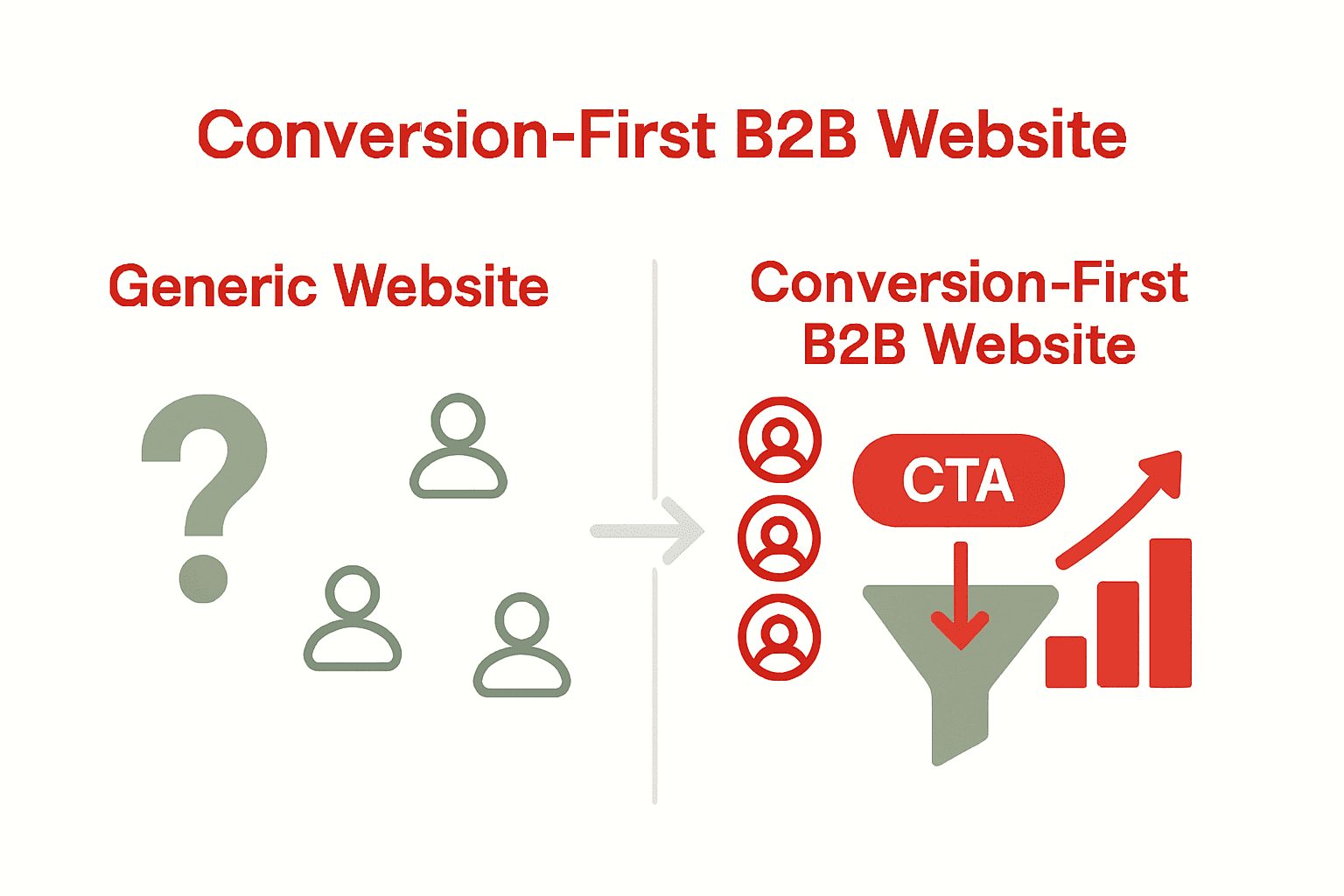 The checklist showed that defining precise audience segments, streamlining on-page elements, and integrating robust lead capture systems are the foundation for consistent conversion. But turning these best practices into a real-world, high-performing website can feel overwhelming, especially when your growth depends on reaching qualified decision-makers and moving them to action fast.
Stop leaving revenue on the table. Our team at ST8 specializes in building fully integrated acquisition systems for high-ticket B2B service providers just like you. Whether you need advanced site architecture, conversion-focused design, or automated lead capture, we turn your website into a reliable growth engine. Curious to see approaches tailored to your business model? Explore successful projects in our Website Building and Strategic Marketing & Business Growth sections. Ready for your next level? Visit ST8 today and start transforming insight into measurable growth.
Frequently Asked Questions
How do I define high-value audience segments for my B2B website?
To define high-value audience segments, create detailed customer personas based on industry verticals, company size, and specific pain points. Begin by analyzing your current clients and conducting market research to gather insights on their needs and challenges.
What are some essential on-page elements to optimize for website conversions?
Key on-page elements to optimize include clear headlines, strategic CTA placement, mobile responsiveness, and minimal form fields. Focus on enhancing one or two elements at a time to see significant improvements in conversion rates.
How can I effectively integrate lead capture systems into my website?
Integrate lead capture systems by defining clear entry points, placing user-friendly forms, and setting up automated follow-up sequences. Aim to capture leads with minimal required information to increase completion rates.
What messaging strategies help convert visitors into leads?
Refine your messaging by addressing audience pain points, articulating unique solutions, and demonstrating measurable impact. Ensure your value proposition answers “What’s in it for me?” within the first few seconds of a visitor landing on your page.
How can I track and optimize my website’s conversion pathways?
Use conversion rate optimization tools to implement A/B testing on critical pathways like lead magnet download pages and service offering landing pages. Regularly analyze key metrics such as conversion rates and bounce rates to identify areas for improvement and optimize your strategy continuously.
What is the importance of A/B testing in improving website conversions?
A/B testing allows you to compare different versions of web pages to determine what resonates best with your audience. Focus on changing only one element at a time to isolate its impact, enhancing performance over time.
Recommended
- Essential Conversion Rate Optimization Guide for B2B Success – ST8
- Understanding Why Optimize for Conversions Matters – ST8
- 7 Effective Marketing Strategies for High Ticket B2B Growth – ST8
- 8 Essential Website Conversion Tips for B2B Success – ST8
The ST8 Review
Find out where you are losing them.
Thirty checks across everything that decides whether you get found, get chosen and get paid, put in the order we would fix them.

